

Why Michael Carrick knows just how important Kobbie Mainoo is to Man Utd
Ignored by Ruben Amorim, the young midfielder is now thriving under a kindred spirit in the Old Trafford dug out

Michael Carrick has done a lot in a very short space of time at Manchester United. And the club’s attacking players like Bryan Mbeumo and Bruno Fernandes clearly stood out in the wins against Manchester City and Arsenal. But what intrigues me the most about the club’s turnaround in form is how Kobbie Mainoo is at the very centre of it all.
Mainoo was notably ostracised from Man Utd’s first team under Ruben Amorim and it’s not hard to see why. In the Portuguese manager’s 3-4-3 system, Amorim needed two expert midfielders that could either defend or attack. There was no room for ambiguity or players that could do a bit of both when it was just two midfielders in the middle of the park, often against three opposing players, and that meant Mainoo was frozen out.
One of the most obvious benefits to Carrick going back to a 4-2-3-1 is that it allowed Mainoo to return to the team as a box-to-box midfielder and as we all saw in the last two games he clearly thrived in his preferred position and role against both Man City and Arsenal. You may have seen the stats posted around the web noting that Mainoo outran all other players in both games, which clearly showcased his determination in the middle of the pitch. But that wasn’t the only stat that stands out in both matches: Mainoo was also third among all Man Utd players for total passes in both games and second only to Bruno Fernandes for total touches across the pitch.
Indeed, what made Mainoo’s return so important to Man Utd in these two games is how he facilitates the players around him. The English midfielder isn’t a world-class defensive midfielder - that’s Casemiro - and he certainly isn’t a league-leading playmaker or No.10 - that’s Fernandes - but he provides the crucial link between the two. A facilitator, if you will, that can help both players in equal measure to get the best out of their game. In other words, it wasn’t so much that Mainoo was the best player on the pitch against Man City or Arsenal but that his presence in midfield allowed Casemiro and Fernandes to be two of the best players in their respective positions.
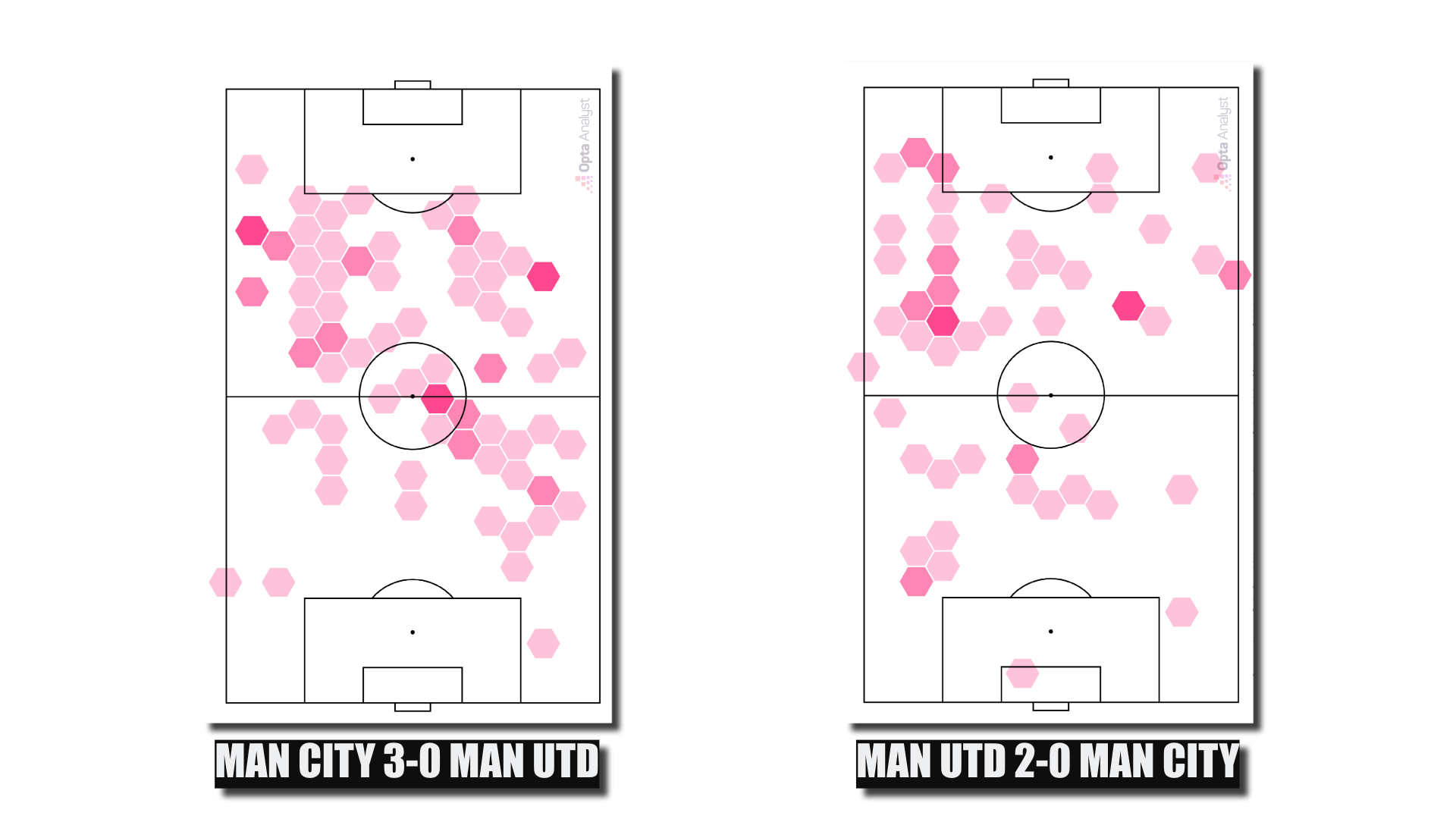
Suddenly Fernandes isn’t having to play in his own half, picking out long balls but is instead in the final third, playing off the forwards. When we compare the player’s heat map (via Opta) in the recent win over Man City and Man Utd’s 3-0 defeat to Pep Guardiola’s team earlier in the season, we can see that in the first game - in which Fernandes was in a midfield duo with Manuel Ugarte - he spent far more time in his own half or around the centre circle, but in the second game he spent far more time in the final third.
And the same can obviously be said of Casemiro, who often got dragged out wide to snuff out counter-attacks before, but now has Mainoo there to cover that ground and let him stay central to protect Man Utd’s back line. That’s something that Amorim never quite understood during his time at Old Trafford but clearly Carrick has been aware of it for quite some time.
Just as a good poem or novel encourages us to read between the lines to comprehend a full picture of what’s going on, football also needs these minor characters to play between the clear stars to build a coherent and fully functioning team. The history of football is full of these somewhat unsung heroes. Whether it be Claude Makélélé, Sergio Busquets or perhaps even Carrick himself during his time at Man Utd. Each of these players knew how to occupy key spaces on the pitch, did the unseen hard work behind the scenes and, crucially, made the players around them much better.
It’s with that in mind that it then comes as no surprise to learn that in an interview with Rio Ferdinand last July, Carrick said Man Utd needed to “have players like that” in reference to Mainoo’s talents in the middle of the pitch and more or less said the Old Trafford club had to build their team around the young midfielder. Now that’s not Carrick saying Mainoo is Man Utd’s answer to problems in attack or defence, he’s simply saying that they always need a player like that in the middle of the park. Someone that can be relied upon to help the players around him in midfield.
And that’s honestly quite refreshing. The sport has become so over-analysed and micro-managed that the concept of a “jack-of-all-trades” is now seen as a bad thing and often sneered at. If a player isn’t a specialist in defence or attack, he’s seemingly useless. That, of course, is complete nonsense. But it’s not hard to see why a manager like Amorim - who is so remarkably rigid with his systems and tactics - would have little room for nuance in his team. And why Man Utd needed someone like Carrick to come along and give Mainoo the space and freedom to flourish at nothing in particular but just do a solid job in the middle of the park.
Obviously those victories over Man City and Arsenal won’t come to define Man Utd’s season or guarantee Carrick the Man Utd job in the summer, but they have done a good job of highlighting why Mainoo is an excellent midfield talent. And, perhaps, have shown Carrick or the man that may come after him how they can get the best out of this team in the coming years.
I'm a sucker for saying this often but football is a simple game, play the best players in their best positions and you'll get the best out of them!
I agree with your comment on the over-analysis and disdain for workhorses and jack-of-all-trades in the modern game, do you think football will come back around to appreciating these players? I’ve heard a lot that the data is never the problem, it’s the conclusions drawn from such data, but it takes a special level of understanding and perception to read between the lines as you say